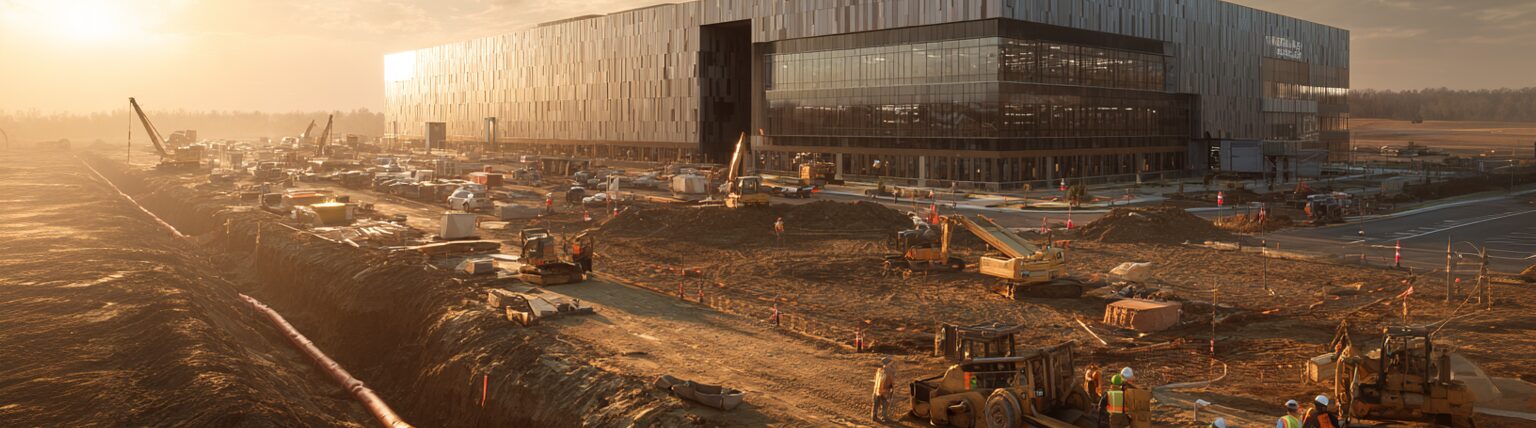
Why Time Is Becoming the Biggest Risk in AI Data Center Development
The AI infrastructure boom has created an unprecedented race for land, power, and connectivity. Investors, developers, and hyperscalers are deploying billions of dollars into new cloud and AI data center opportunities, often focusing on securing power capacity and acquiring strategically located parcels of land.
But there is a growing reality many investors are discovering too late:
Money may not be the biggest challenge in bringing connectivity to a new data center. Time is.
In many cases, investors have the capital available to build whatever fiber infrastructure is required. The problem is that writing a check does not eliminate the permitting, engineering, easement negotiations, carrier coordination, and construction timelines required to bring that connectivity to life.
As a result, fiber infrastructure is becoming one of the most significant schedule risks in modern data center development.
The Misconception: “We’ll Just Build the Fiber”
Many investors assume that if fiber is not readily available, they can simply fund a network expansion and move forward.
Unfortunately, fiber deployment rarely works that way.
Building a new fiber route involves far more than placing cable in the ground. Depending on the location, developers may need to navigate:
- Municipal permitting
- Railroad crossings
- Water crossings
- Utility coordination
- Environmental reviews
- Right-of-way acquisition
- Carrier negotiations
- Engineering and route design
Each step introduces potential delays. While none of these challenges are impossible to overcome, they require time often far more time than investors initially anticipate.
The result is that a project with available land and power may still be unable to enter service because connectivity cannot be delivered on the same timeline.
Why Tier 2 Markets Face the Greatest Risk
The challenge becomes even more pronounced in secondary and emerging data center markets.
Many of these locations offer attractive advantages, including lower land costs, available power, favorable tax incentives, and strong economic development support. These factors make them highly attractive for AI and cloud infrastructure expansion.
However, these same markets often have the least developed fiber ecosystems.
Unlike major metropolitan areas, Tier 2 markets may have:
- Limited carrier presence
- Fewer long-haul fiber routes
- Minimal dark fiber availability
- Reduced route diversity
- Longer distances to major network infrastructure
As a result, connecting a new facility may require substantial network expansion before the first server is ever installed.
In some cases, the timeline for bringing adequate fiber connectivity to a site can rival or even exceed portions of the facility construction schedule itself.
The Cost of Delayed Connectivity
For investors, fiber delays create more than operational headaches.
They create financial consequences.
Every month that a facility cannot go live affects:
- Revenue generation
- Tenant occupancy schedules
- Financing assumptions
- Debt servicing plans
- Internal rate of return (IRR)
- Exit timing and valuation
A delay of six months, twelve months, or longer can materially alter the economics of a project.
The challenge is not necessarily the cost of constructing the network. Many investors are willing to fund infrastructure improvements when the opportunity justifies the expense.
The challenge is understanding how long those improvements will take and incorporating that reality into project planning from the beginning.
Why Phase One Fiber Analysis Is Critical
This is where many projects make a costly mistake.
Fiber infrastructure is often evaluated too late in the development process.
Developers identify a promising site, secure power discussions, negotiate land agreements, and begin project planning before fully understanding the realities of the surrounding connectivity ecosystem.
By the time connectivity challenges emerge, the project schedule is already committed.
That is why the first and arguably most important step in any data center development opportunity is a comprehensive Phase One Fiber Analysis.
A proper analysis should evaluate:
- Distance to existing fiber routes
- Carrier presence
- Available capacity
- Dark fiber opportunities
- Route diversity
- Expansion feasibility
- Permitting considerations
- Construction requirements
- Potential schedule risks
This assessment helps investors understand whether connectivity can support project timelines before major capital commitments are made.
How Edgeology Helps Accelerate Connectivity Planning
Edgeology helps investors and developers understand the realities of fiber infrastructure before connectivity becomes a project bottleneck.
Through its ecosystem of carriers, Outside Plant (OSP) engineering firms, construction partners, and large and small network operators, Edgeology helps clients evaluate opportunities and develop practical strategies for bringing scalable connectivity to new data center developments.
Edgeology can assist throughout the entire connectivity lifecycle, including:
- Fiber infrastructure analysis
- Carrier engagement
- Dark fiber sourcing
- Route diversity planning
- OSP engineering coordination
- Network expansion strategy
- Connectivity risk assessment
- Infrastructure deployment planning
Most importantly, Edgeology helps clients understand what is realistically achievable and how long it will take to get there.
Time Is the New Constraint
For years, the industry viewed power as the primary limiting factor in data center development.
Today, many developers are finding creative ways to solve power challenges through utility partnerships, onsite generation, microgrids, and hybrid energy strategies.
Fiber infrastructure presents a different challenge.
There is no shortcut around permitting. There is no substitute for route diversity. And there is no way to accelerate every aspect of network construction simply by increasing the budget.
In many markets, particularly secondary markets, connectivity timelines are becoming one of the most important factors determining when a project can begin generating revenue.
Conclusion
The next generation of AI and cloud infrastructure will require more than land and power.
It will require scalable, resilient fiber connectivity.
While capital can fund network construction, it cannot eliminate the time required to engineer, permit, coordinate, and build that infrastructure. For many projects, the true risk is not whether fiber can be delivered it is how long it will take.
That is why investors should evaluate connectivity as early as possible.
The sooner a project’s fiber realities are understood, the sooner teams can develop realistic schedules, reduce uncertainty, and avoid costly delays.
If your organization is evaluating a new AI or cloud data center opportunity, now is the time to understand the connectivity landscape surrounding the site.
Because when it comes to fiber infrastructure, time may be the most valuable resource of all.
Ideally, fiber should be evaluated before land acquisition or during the earliest stages of due diligence. Waiting until after a site is selected can result in unexpected delays, increased costs, and missed revenue targets. Edgeology helps investors assess connectivity viability from the beginning.
A facility may be physically ready for operation but unable to support customers, cloud services, or AI workloads until connectivity is established. This can delay occupancy, revenue generation, and return on investment. Early connectivity planning helps prevent this scenario.
While additional capital can help fund construction, it cannot eliminate permitting timelines, railroad approvals, environmental reviews, easement negotiations, or municipal processes. Many of the longest delays are administrative rather than financial. Edgeology helps identify these schedule risks early so projects can be planned accordingly.
Yes. While these markets often offer attractive land prices, available power, and tax incentives, they frequently have fewer carriers, less dark fiber availability, and limited route diversity. As a result, new fiber construction often requires longer lead times and more complex planning.
While no company can eliminate permitting or construction requirements, Edgeology works with carriers, OSP engineering firms, construction partners, and network operators to identify practical solutions, alternative routes, existing assets, and creative deployment strategies that may reduce schedule risk.