
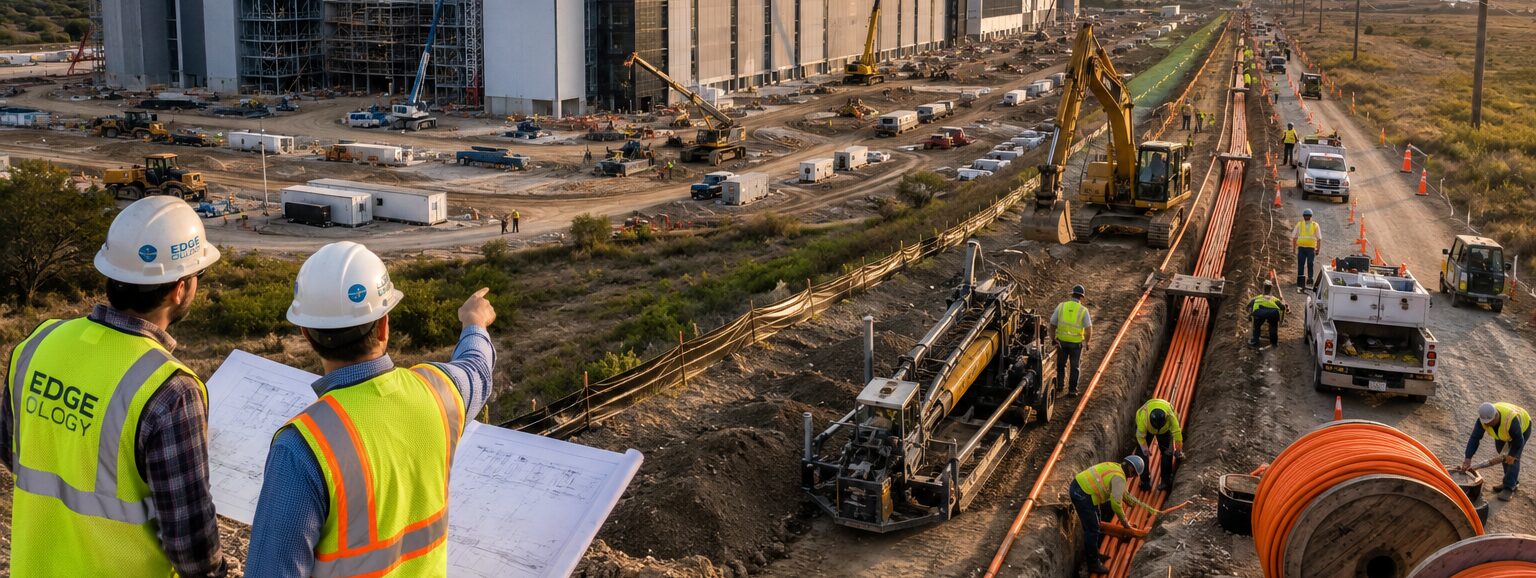
Why Secondary Markets Need More Fiber Before They Need More Data Centers
The next wave of AI and cloud data center development is expanding beyond traditional hyperscale markets.
As land prices rise and power availability tightens in Northern Virginia, Silicon Valley, Phoenix, and Dallas, developers and investors are increasingly looking toward secondary markets such as Austin, San Antonio, Reno, Columbus, Denver, and Salt Lake City. These regions offer attractive land prices, expanding power infrastructure, growing workforces, and competitive tax incentives all ingredients for successful data center development.
However, many of these emerging markets share a common challenge that is often overlooked during early due diligence:
Their fiber ecosystems have not grown at the same pace as investor demand.
This has created a classic chicken-and-egg problem that threatens to slow the next generation of AI infrastructure.
Developers Need Fiber Before They Can Build
AI and cloud data centers require more than land and power. They require high-capacity, low-latency connectivity capable of moving enormous volumes of data between customers, cloud regions, and AI clusters.
Without robust fiber infrastructure, a data center cannot fully participate in the digital economy.
Unfortunately, many secondary markets have:
- Fewer long-haul fiber corridors
- Limited carrier diversity
- Scarce dark fiber availability
- Minimal route redundancy
As developers pursue sites in these regions, they often discover that the connectivity required to support hyperscale AI workloads simply is not there or will take years to construct.
Carriers Need Demand Before They Build
From the perspective of fiber network operators, building new long-haul routes is a major capital investment.
Constructing new fiber requires engineering, permitting, easements, railroad and water crossings, environmental reviews, and significant financial resources.
Carriers generally want confidence that demand will justify the investment before committing millions of dollars to new infrastructure.
In other words, carriers want to see data center projects before they expand their networks.
Developers Need Networks Before They Commit Capital
Data center developers and investors face the opposite challenge. Before investing hundreds of millions—or even billions—of dollars in a new campus, they need assurance that scalable, redundant connectivity will be available when the facility comes online.
Without that certainty, projects carry greater schedule risk, operational risk, and financial uncertainty. As a result, developers often hesitate to move forward until they have confidence in the surrounding fiber ecosystem.
The result is an impasse: developers are waiting for fiber, carriers are waiting for demand, and neither side wants to move first.
Why AI Is Changing the Equation
Historically, this dynamic evolved gradually because traditional enterprise workloads generated predictable network demand.
Artificial intelligence is different.
AI clusters require significantly more bandwidth, lower latency, and greater resiliency than previous generations of data centers. Hyperscalers are deploying increasingly dense compute environments that place enormous demands on transport networks.
As AI adoption accelerates, the need for diverse, scalable fiber infrastructure grows just as rapidly.
Markets that fail to expand their fiber ecosystems risk losing future investment to regions that can provide both power and connectivity.
Secondary Markets Represent the Next Growth Opportunity
Cities such as Austin, San Antonio, Reno, Columbus, Denver, and Salt Lake City are well positioned to become major AI infrastructure hubs. These markets offer many competitive advantages:
- Lower development costs
- Growing access to power
- Business-friendly environments
- Strong transportation infrastructure
- Available land for campus-scale developments
Yet their long-term competitiveness will increasingly depend on the strength of their telecommunications infrastructure. Power may attract developers to a market, but fiber determines whether they stay.
Building Fiber Benefits More Than Data Centers
Investing in fiber infrastructure creates value far beyond supporting AI workloads. New fiber routes strengthen regional economies by enabling business expansion, broadband growth, cloud adoption, telemedicine, remote work, educational opportunities, 5G and wireless backhaul, and future Internet exchanges and edge infrastructure.
Every new long-haul fiber corridor becomes a foundation for broader economic development, and communities that invest in connectivity are investing in long-term digital competitiveness.
Breaking the Cycle Requires Early Collaboration
The chicken-and-egg problem cannot be solved by developers or carriers acting independently.
It requires collaboration among investors, carriers, engineering firms, utilities, economic development organizations, and infrastructure advisors.
Connectivity planning must become part of the earliest stages of site evaluation—not something addressed after land has been acquired.
By understanding existing fiber assets, identifying gaps, evaluating expansion opportunities, and engaging carriers early, developers can reduce uncertainty and help create the confidence needed for network investment.
How Edgeology Helps Move Projects Forward
Edgeology helps bridge the gap between data center development and fiber infrastructure planning.
Before significant capital is committed, Edgeology works with investors and developers to evaluate the connectivity readiness of prospective sites. Through comprehensive fiber analysis, carrier engagement, Outside Plant (OSP) engineering coordination, dark fiber strategy, and connectivity risk assessments, Edgeology provides clients with a clear understanding of what infrastructure exists today and what will be required tomorrow.
Rather than waiting for connectivity challenges to emerge during construction, Edgeology helps clients identify practical solutions early in the development process. By working with carriers, engineering partners, and fiber network operators, Edgeology helps reduce uncertainty, improve project planning, and position developments for long-term success.
Conclusion
The future of AI infrastructure will not be determined solely by where power is available.
It will also be determined by where high-capacity, resilient fiber networks can support the next generation of compute.
Secondary markets have enormous potential to become the next wave of AI and cloud data center hubs. However, realizing that potential will require expanding fiber infrastructure ahead of demand—not years after it arrives.
The markets that solve this chicken-and-egg problem first will be the ones that attract the next generation of hyperscale investment. For investors, developers, and communities alike, the message is clear: the time to plan for connectivity is before the first shovel hits the ground.
While developers are finding innovative ways to address power constraints through onsite generation and microgrids, fiber infrastructure still requires extensive engineering, permitting, carrier coordination, and construction. A project may have power and land, but without timely connectivity, it cannot support customers or generate revenue. Edgeology helps investors identify these risks before they affect project timelines.
Markets such as Austin, San Antonio, Reno, Columbus, Denver, and Salt Lake City are attracting significant AI data center investment because of available land and power. However, many of these markets have less dense fiber infrastructure, fewer carrier options, and limited dark fiber availability. Edgeology evaluates the existing network ecosystem and helps develop strategies to overcome these connectivity challenges.
Edgeology works with carriers, Outside Plant (OSP) engineering firms, construction companies, and fiber network operators to evaluate existing infrastructure, identify expansion opportunities, and develop practical connectivity strategies. By addressing these issues early, investors can make more informed decisions and better manage project timelines.
One of the most common mistakes is evaluating fiber too late in the development process. Many projects focus first on land, power, and incentives, only to discover later that fiber infrastructure requires significant time and investment. Early connectivity analysis helps prevent costly delays and unexpected capital expenditures.
Carriers need time to evaluate network expansion opportunities, engineering requirements, and construction schedules. Engaging them early can identify available capacity, potential dark fiber opportunities, and realistic deployment timelines. Edgeology facilitates these discussions to help move projects forward more efficiently.
A Phase One Fiber Analysis evaluates the proximity of existing fiber routes, available capacity, carrier presence, route diversity, and the feasibility of expanding connectivity to a site. It provides investors with an early understanding of whether a property can realistically support a cloud or AI data center and what challenges may need to be addressed.