
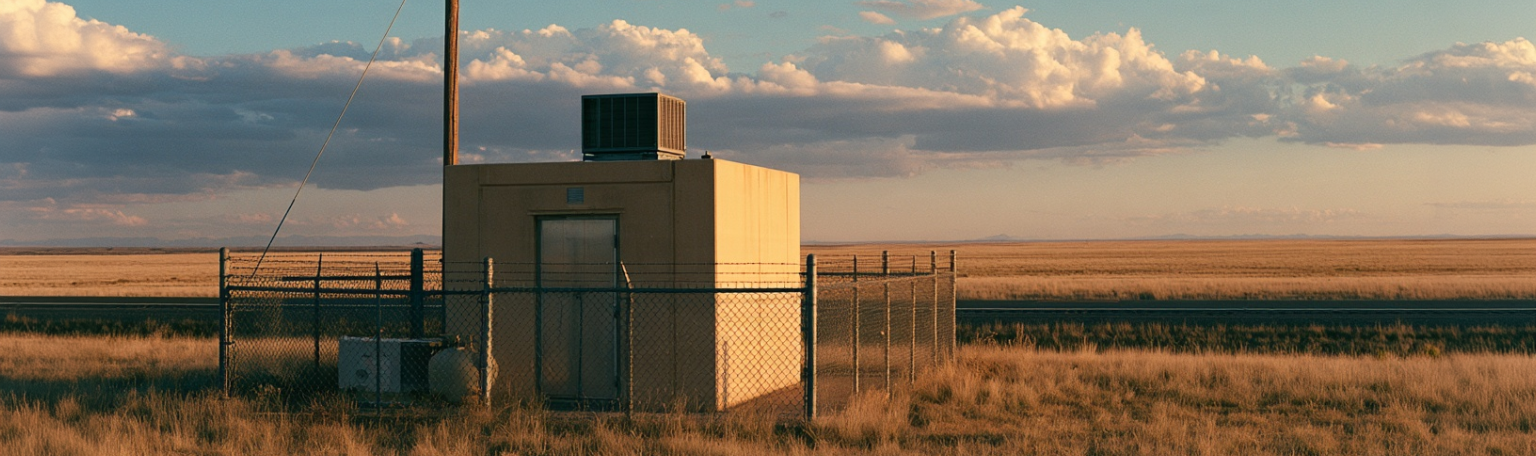
On a map, a long-haul fiber route is a single line between two cities. In reality, it’s a chain of small buildings strung along that line every few dozen miles. Each one sits on its own piece of land, draws its own power, and needs its own access road, cooling, and permits.
These are amplifier huts, sometimes called in-line amplifier (ILA) sites. Most investors never see them, and few diligence reports mention them. But every long-haul route depends on them, and every new route has to build them. As AI pushes more traffic across longer distances, the huts are becoming one of the quiet constraints on how fast new connectivity can be delivered and upgraded.
What an amplifier hut is, and why routes need so many
Light weakens as it travels through glass. Over a long enough distance, the signal fades below what the receiving equipment can read. Amplifier huts solve that. Each one houses equipment that boosts every wavelength on the fiber at once, so the signal can continue to the next hut.
Spacing has stretched as fiber and optics improved. Early sites were placed 18 to 25 miles apart; today they typically sit 50 to 60 miles apart. Terrain, fiber quality, and splice losses can pull that closer on any given route.
The arithmetic adds up quickly. A 500-mile route needs roughly eight to ten huts between its endpoints. Long-haul operators each run hundreds or even thousands of these sites, and the count is growing as new routes are built to serve AI data centers.
The huts are not optional. Without them, long-haul networks fail and intercity connectivity between data centers goes down.
A small data center every 50 miles
An amplifier hut is often described as a shed. Functionally, it’s closer to a miniature data center. As one operator put it, these sites have everything a big data center has in a smaller format: A and B power and uninterruptible power supplies. A typical site needs:
| Requirement | What it involves |
| Land | A fenced parcel near the fiber path, owned or leased, usually for decades |
| Utility power | A service drop sized for today’s equipment and future upgrades |
| Backup power | Batteries plus a generator and on-site fuel, since an outage breaks the whole route |
| Cooling | HVAC that keeps electronics within range through desert summers and northern winters |
| Access | A road crews can use year-round, often in remote terrain |
| Permits | Zoning, building, electrical, and sometimes environmental approvals, county by county |
| Security and monitoring | Fencing, alarms, and remote monitoring for an unstaffed site |
The structure itself is usually the easy part. Shelters are often prefabricated, trucked in, and lifted by crane onto a concrete pad with access to power. The hard parts are the parcel, the power, and the permits, repeated at every site along the route.
Why huts matter to data center investors
New routes are hut projects. When a site needs a new long-haul path, the cable is only part of the build. A route of several hundred miles can require a dozen or more new huts, each with its own land deal, power service, and permits. Any one of them can hold up the whole route. In our experience, hut count is one of the clearest signals of whether a proposed long-haul option is a plan or just a contingency.
Dark fiber is useless without hut space. Buying or leasing dark fiber on an existing route only works if you can also place amplifiers at every hut along it. If an IRU doesn’t include rack space, power, and access at each site, the strands can’t be lit end to end. This is one of the most commonly overlooked terms in long-haul fiber deals.
Hut capacity limits growth. The size of a hut can limit how many fibers can actually be amplified, even when the cable has 864 strands. A route with plenty of spare glass may still be capped by full huts.
Power is the new constraint. Early hut designs supported around 600–800 W per rack. Newer sites are being built far larger: one U.S. provider says its sites offer 155 kW, expandable to 465 kW, with 72 hours of on-site fuel. Opening the L-band or adding new line systems takes more amplifiers, which means more power and cooling at every site. On older routes, the hut’s electrical service can become the bottleneck.
Huts are assets in their own right. For landowners, a hut is a long-term ground lease. For route owners, well-powered huts with spare space can be sold to other carriers. Some in the industry are also asking whether better-powered huts could eventually host small amounts of compute beyond amplification.
Questions to ask about the huts on any route
- How many huts sit between the site and the nearest major interconnection point, and who owns each one?
- Does our IRU or lease include rack space, power, and 24/7 access at every hut, or only the strands?
- How much spare space, power, and cooling is left at each site for our equipment and future upgrades?
- Can the huts support C+L band or a second line system without new electrical service?
- What backup power does each site have, and how many hours of fuel are kept on site?
- For a new route: how many new huts are needed, and have land, power, and permits been identified for each?
- Are any huts on leased land with terms that expire before our investment horizon?
If no one on the deal team can answer these, the route’s capacity and schedule haven’t really been underwritten.
The bottom line
A long-haul route is only as strong as its weakest hut. Every 50 or so miles, its capacity, uptime, and upgrade path depend on a small building most investors never see. For new routes, the huts often set the schedule. For existing routes, they often set the ceiling.
Edgeology’s engineers look past the line on the map to the infrastructure that keeps it lit: ownership, hut access, power, and room to grow. If you’re evaluating a site that depends on long-haul connectivity, book a 30-minute scoping call and we’ll outline what a route assessment would cover.