AI data centers are changing the economics and engineering of digital infrastructure. Investors and developers have focused on power availability, cooling capacity, land, and construction timelines. But another fundamental change is taking place: the amount, architecture, and physical design of fiber required to make an AI data center work are changing dramatically.
Traditional data centers were largely designed around workloads in which servers communicate with users, applications, and storage. AI training clusters introduce a different challenge. Thousands of GPUs must exchange enormous volumes of data with one another, often simultaneously. The result is a much denser internal network, more demanding optical connections, and a greater need for precise planning of cable pathways, rack layouts, and network topology.
The changes do not stop at the building. AI infrastructure also depends on high-capacity fiber connecting facilities to other data centers, cloud networks, compute campuses, and carrier infrastructure. These external connections can influence where a facility should be built, how quickly it can become operational, and whether it can scale as demand grows.
For investors and developers, fiber design is no longer a detail to leave until the network team arrives. It is a core part of AI infrastructure planning.
1. AI Changes the Fiber Equation Inside the Data Center
The physical requirements of AI computing are driving a different approach to data center whitespace—the space that houses server racks, networking equipment, and supporting infrastructure.
Conventional server racks have historically operated at power densities measured in single-digit kilowatts, although traditional environments vary considerably. AI racks can demand tens or more than 100 kilowatts, with specialized high-density configurations moving substantially higher. That concentration of compute requires corresponding changes in power delivery, cooling, and networking.
The fiber impact comes from how GPUs work together.
In a conventional enterprise environment, a significant portion of network traffic moves between servers and external users, applications, or storage. This is commonly described as north-south traffic. AI training adds intense east-west traffic: communication among GPUs and servers as they distribute data, exchange intermediate results, and synchronize computation.
A large AI cluster may need separate network fabrics for GPU compute, storage, management, and external connectivity. The exact configuration depends on the workload and system architecture, but large deployments can require thousands of high-speed optical links.
That changes the physical infrastructure required to support the computing equipment. Fiber count, connector density, cable routing, and switch placement all become more important—and more difficult to retrofit after installation.
Some industry estimates suggest that AI facilities can require many times more fiber than conventional data centers. Figures such as 10 to 36 times more are useful indicators of the potential scale of the change, but they should not be treated as a universal multiplier. Actual requirements depend on GPU count, network topology, optical interface design, redundancy, and the extent of the facility included in the comparison.
The investment implication is straightforward: a whitespace design sized for conventional cloud workloads may not be appropriate for an AI cluster.
2. Whitespace Buildouts Become an Exercise in Network Architecture
In AI facilities, fiber is not simply installed wherever space remains available. The physical cabling plan must follow the network architecture.
Many large GPU deployments use leaf-spine or fat-tree designs, sometimes with rail-optimized connections and multiple network planes. These configurations are designed to provide high bandwidth, predictable communication paths, and the ability to scale clusters without creating network bottlenecks. Some architectures use InfiniBand; others use Ethernet-based technologies such as RoCE.
The architecture determines how servers connect to switches, how switch layers connect to one another, and how many links are required between components. That, in turn, determines the number and type of optical transceivers, fiber strands, trunks, connectors, and patching points.
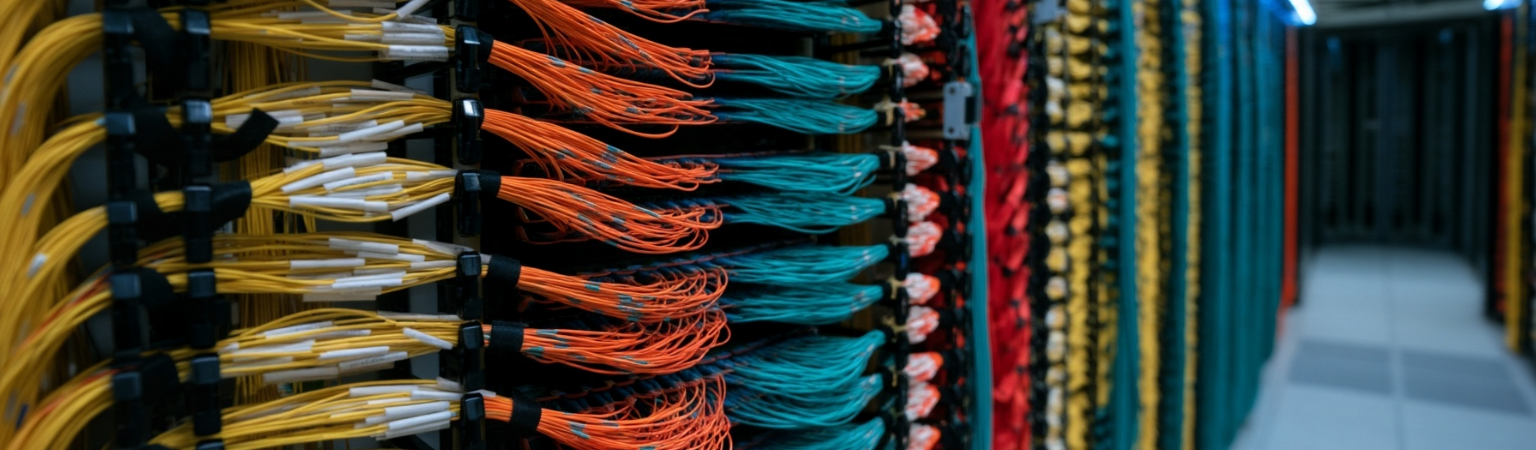
Higher-speed optical interfaces do not automatically mean fewer cables or less fiber. Depending on the transceiver and cabling design, a connection may use duplex fiber, parallel fiber, or breakout configurations. Multi-fiber MPO or other high-density connector systems can simplify large installations, but they also make polarity, labeling, connector selection, and cable management critical.
For developers, the lesson is that fiber design must begin alongside the network topology—not after the racks and cable trays have been finalized.
Pathway capacity becomes a design constraint
High-density cabling can quickly consume overhead tray space, vertical cable pathways, and rack-level routing capacity. Cable diameter, bend radius, weight, access for installation, and separation from other building systems all matter.
Engineers must plan routes that accommodate the initial deployment while leaving room for additional links, replacement cables, and future capacity. High-density ribbon cable, compact connectors, modular trunks, and smaller-form-factor components can help, but they do not eliminate the need for sound pathway engineering.
A design that fits on a drawing may still be difficult to install, inspect, or maintain in the field.
Fiber must coexist with power and liquid cooling
AI whitespace is a coordination challenge. High-capacity electrical distribution, busways, liquid-cooling manifolds, coolant lines, and fiber pathways must all fit within a constrained physical environment.
Poor coordination can obstruct service access, complicate maintenance, or create conflicts during installation. A technician replacing a network connection should not have to disturb a cooling line or disconnect neighboring equipment to reach it.
This makes detailed three-dimensional coordination, installation sequencing, and maintainability important elements of the buildout. These are not merely operational concerns. Rework and commissioning delays can affect the schedule for bringing expensive compute capacity online.
Optical performance depends on physical execution
High-speed optical links have defined limits for insertion loss, connector quality, and other channel characteristics. Excessive bends, damaged connectors, contamination, poor splices, and incorrect polarity can prevent a link from meeting its performance requirements.
As link speeds and port densities increase, disciplined installation and testing become essential. Pre-terminated assemblies can reduce some field-installation risks, but only when lengths, connector types, polarity, and routing are engineered correctly.
For investors and developers, this translates into a practical question: has the fiber infrastructure been designed and validated for the intended network, or has cabling been treated as a commodity to be fitted in later?
3. Fiber Design Must Anticipate the Next Upgrade
AI networking technology is advancing quickly. Higher-speed optics, new switch platforms, evolving GPU systems, and changing network architectures can alter the number of connections, the type of fiber assemblies, and the capacity required between racks.
A facility designed around one generation of equipment may need additional fiber, new trunks, or different connectivity arrangements when the next generation arrives. Not every upgrade requires replacing the cabling plant, but assuming that all future upgrades will fit the original design can be expensive.
Developers should therefore distinguish between initial capacity and expandability. A robust design considers spare fibers, pathway headroom, accessible patching, modular distribution, and a practical way to add new rows or clusters without disrupting existing operations.
This is particularly important for phased developments. If a campus will add AI capacity in stages, the first phase should not unintentionally constrain the second. Backbone pathways, meet-me rooms, entrance facilities, and internal distribution should be planned around the intended buildout—not just the first group of racks.
The objective is not to overbuild every component. It is to understand which elements are difficult or expensive to change later and reserve the right options before construction closes them off.
4. The External Fiber Network Is Changing, Too
Inside the building, fiber connects GPUs, switches, storage, and other systems. Outside the building, fiber connects the facility to the wider digital infrastructure ecosystem.
These are different engineering problems, but they are tightly connected.
A large AI facility may need high-capacity data center interconnect (DCI) to reach other compute sites, cloud regions, storage locations, network hubs, and customer environments. Some AI workloads depend on moving large datasets between locations. Others require low-latency connectivity or diverse routes to support availability and resilience.
The required design depends on the workload. Not every AI facility needs the same latency, capacity, or geographic footprint. But developers should understand the intended connectivity model before committing to a site.
Key questions include:
- Which carriers and fiber owners serve the site, and what capacity can they actually deliver?
- How close are practical interconnection points, carrier hotels, and relevant network hubs?
- Are proposed routes physically diverse, or do they share vulnerable infrastructure?
- Can the site support the required bandwidth today, with a credible path to expand it?
- What new construction, easements, rights-of-way, crossings, or permitting would be required?
- How long will carrier coordination, engineering, and deployment take?
A line on a fiber map is not proof that a site has usable capacity. Nor does the presence of multiple carriers necessarily guarantee physically diverse routes. The details must be verified.
For developers evaluating locations outside established data center markets, this diligence can be especially consequential. Lower land costs or attractive power arrangements may be offset by limited carrier presence, constrained routes, or long lead times to build new infrastructure.
Fiber proximity is not the same as fiber readiness.
5. More Capacity Requires More Than More Fiber
The external network is evolving alongside the internal one. Higher-capacity coherent optics, improved optical line systems, and advances in network management can help operators carry more traffic over existing infrastructure or use available spectrum more effectively.
These technologies can improve the economics of some network upgrades. But they cannot solve every physical constraint.
Available capacity depends on the actual route, fiber characteristics, optical system, distance, equipment, and engineering margins. A higher-capacity transceiver cannot create a second physically diverse route where none exists, secure an easement, or accelerate a difficult construction project by itself.
The same principle applies to new builds. Developers should not assume that a nearby route can support the planned workload without carrier confirmation and technical assessment. Nor should they assume that a new connection can be delivered within the building schedule simply because fiber infrastructure exists nearby.
The most effective strategy combines an understanding of optical technology with detailed knowledge of physical infrastructure: routes, ownership, capacity, interconnection options, diversity, and deployment constraints.
6. What Investors and Developers Should Evaluate Before Committing Capital
Fiber diligence should run in parallel with power, land, cooling, and construction planning. It should also account for both the internal network and the external connections needed to make the facility commercially useful.
Before advancing a project, investors and developers should establish five things.
First, define the intended compute architecture. Understand the target GPU configuration, network topology, optical interfaces, and expected deployment phases. Without these inputs, fiber requirements are difficult to estimate credibly.
Second, validate the internal cabling design. Review fiber counts, cable pathways, connector systems, rack layouts, bend-radius requirements, installation access, testing procedures, and capacity for future expansion. Confirm that the design coordinates with power and cooling infrastructure.
Third, verify external connectivity. Identify the actual fiber owners and carriers, confirm available capacity and interconnection options, and assess route diversity. Distinguish existing infrastructure from proposed or assumed future construction.
Fourth, understand delivery risk. Establish what must be built, who must approve it, which easements or rights-of-way are needed, and what dependencies could affect the schedule. A connectivity plan should include realistic engineering and deployment milestones.
Fifth, protect future options. Consider how the facility will accommodate higher-speed optics, additional GPU clusters, new buildings, and expanded external bandwidth. Preserve pathways and route options where the cost of doing so now is materially lower than retrofitting them later.
These steps help connect technical decisions to the issues investors ultimately care about: capital expenditure, time-to-revenue, tenant commitments, operational resilience, and the ability to scale the asset.
Fiber Design Is Now Part of the Investment Thesis
AI infrastructure is changing too quickly for developers to treat fiber as a late-stage cabling package. Inside the data center, GPU clusters demand a denser and more carefully coordinated optical network. Outside the facility, AI workloads depend on high-capacity connectivity that must be verified, engineered, and delivered on a realistic schedule.
Both sides affect project viability.
A well-designed internal fiber plant helps the facility support its intended compute architecture and future upgrades. A well-planned external network helps connect that capacity to the rest of the AI ecosystem. Weakness in either can create avoidable costs, delays, or limitations on growth.
For professional investors and developers, the takeaway is clear: evaluate fiber as a core infrastructure requirement from the beginning—not as a detail to resolve after the site is selected.
Edgeology helps investors and developers assess fiber connectivity, identify infrastructure and deployment risks, evaluate routing options, and plan the path from site selection through implementation. Whether a project involves an existing data center, a new AI campus, or a site in an emerging market, understanding the fiber is essential to understanding the opportunity.
Before you commit capital, know what the fiber can support—and what it will take to build what is missing.
Contact Edgeology to discuss fiber readiness and connectivity planning for your next data center project: https://edgeology.co/contact/