
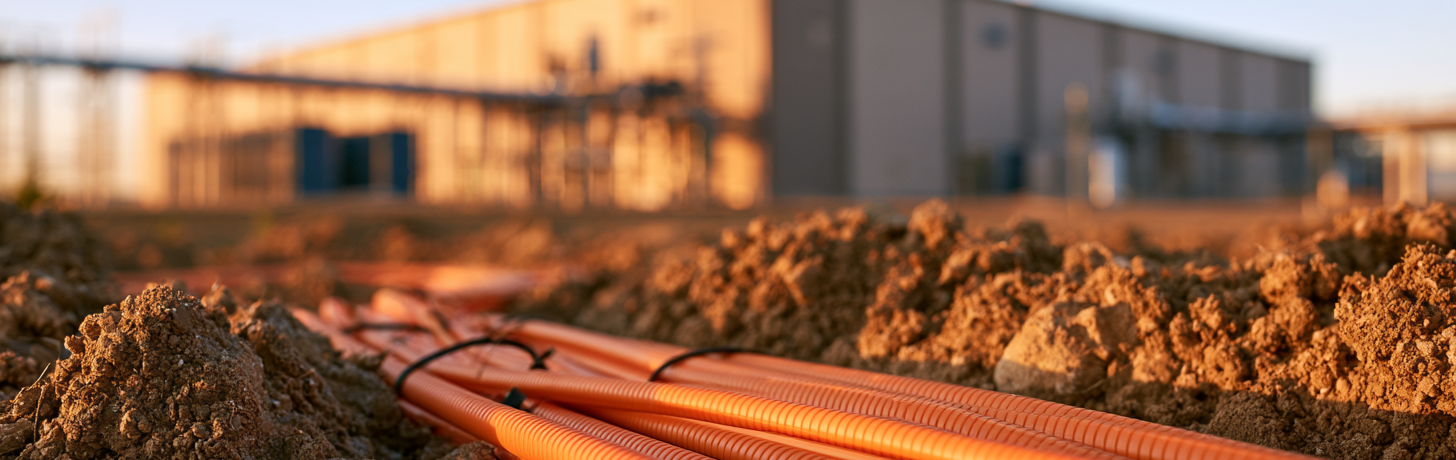
Ask a landowner, a broker, or a coverage map whether a site has fiber, and the answer is almost always yes. There is a long-haul route two miles away. Three carriers run down the interstate. The fiber is “right there.”
For an AI data center, “right there” is not the same as connected. The distance between a carrier’s route and your building’s fence line is called the last mile. Closing it usually means designing, permitting, and building new infrastructure. In our work it is the part of fiber diligence most likely to be underpriced, and the most likely to move a delivery date.
The mindset shift is simple. Unless a carrier can show you lit capacity at the property line today, treat connectivity as a construction project with its own budget, schedule, and risk. Don’t treat it as a utility hookup.
What the last mile actually involves
The last mile is every physical piece between a carrier’s existing network and the equipment inside your building. On a typical greenfield site, that includes:
- A splice point on the existing route. That’s the manhole or handhole where a carrier is willing to open its cable and hand off strands. It may not be the nearest point to your parcel. It’s wherever the carrier has a usable splice location and spare fiber.
- The lateral. That’s the new cable run from the splice point to the property, which might be a few hundred feet or many miles. Most of the cost and schedule sits here.
- The path the lateral takes. It runs along public roads, across private parcels, under rail lines and highways, or over existing utility poles. Each type of crossing has its own permits and owners.
- Building entrances. Large AI deployments typically want two or more entrances on physically separate sides of the campus. That often means two laterals, not one.
- Capacity behind it. The lateral only helps if the route it connects to has strands or wavelengths you can actually buy, today and for later phases.
A coverage map shows you step 5 at best. Steps 1 through 4 are the last mile, and none of them exists until someone builds it.
Pattern one: the site that looks connected but isn’t
A common scenario: a large industrial parcel with land, power potential, and several carriers active in the region. On a map, it looks well positioned. On the ground, the physical setting works against it. A river, an active freight rail corridor, or a limited-access highway sits between the parcel and the nearest routes, and only one road reaches the site.
In situations like this, it’s not unusual to find that no carrier has fiber at or near the property. Every credible path requires new construction around or across those barriers. The options typically look something like this:
| Option | What it usually involves | Typical timeline | Cost profile |
| Carrier route extension | A carrier extends an existing or planned route to the site, sometimes tied into a regional ring | 2–4+ years, depending on strand count | Tens of millions in non-recurring cost, before any fiber IRU |
| Rail or highway corridor build | A new standalone route along a transportation corridor | 2–3 years, after a feasibility study | Study costs first, then major capital |
| Utility or pipeline right-of-way | A shared or joint-venture build along existing utility right-of-way | Can be faster than a standard build | Joint-venture or financing structure rather than straight capex |
| Detour around the barrier | A longer route that goes around the river or rail line | Often uncommitted | Millions to tens of millions, before permits and equipment |
| Long-haul new build | Hundreds of miles of new route with new amplifier huts | Uncommitted contingency | Can reach nine figures |
| Aerial interim route | Fiber on existing poles while underground work finishes | Months rather than years | Lower, but tenant acceptance is required |
The verdict on sites like this is rarely “no fiber.” Connectivity is usually achievable. But the fastest path may approach three years, and the leading option can be an eight-figure line item. That belongs in the development model on day one, not in a footnote after closing. Sites in this position are best marketed to anchor tenants as construction-dependent, not fiber-ready.
Pattern two: the strong site that still has a last mile
The opposite scenario is just as instructive. Picture a group of candidate parcels along a major interstate fiber corridor. Several backbone carriers are within reach, and modeled latency to a major interconnection hub is low. By most desk-based scoring, these sites rank near the top.
Even the best of them still have a last mile to solve. Laterals from the corridor to parcels like these commonly run anywhere from a couple of miles to six or more. Those distances are short by long-haul standards. Each one is still a design, permitting, and construction effort with its own right-of-way questions.
Two caveats apply to almost any desk-based review:
- Carriers sharing a corridor may also share a trench. Four carriers along one interstate can look like four diverse routes. If they run through the same conduit for hundreds of miles, a single cut can take them all down. Physical diversity has to be field-verified.
- Advertised routes aren’t confirmed capacity. Until a carrier names a splice point and commits lit or dark capacity, the lateral’s length, cost, and timeline are estimates.
The lesson is that a high score narrows the risk without removing it. Good sites still carry a construction schedule. The goal of diligence is to know that schedule before capital is committed.
Where the time and money go
Last-mile builds commonly take 6 to 18 months on straightforward sites, and far longer when geography works against you. The drivers are predictable once you know where to look:
- Right-of-way and easements. Crossing a rail line, a state highway, or a private parcel each requires its own agreement or permit. These run on their own clocks, independent of construction. Rail crossings in particular can take months to approve.
- Construction method. Directional boring under roads and waterways costs more per foot than open trenching but is often the only option. Rock, wetlands, and river crossings push costs higher still.
- Aerial vs. underground. Hanging fiber on existing utility poles can be faster and cheaper. It is also more exposed to storms and vehicle strikes, and some tenants won’t accept it as a permanent solution. It works best as an interim bridge while underground construction finishes.
- Route length and equipment. Optical signals need regeneration or amplification over long distances. A long new build may require equipment huts along the way, each with its own land, power, and permits. On a long new build, those huts can add up quickly.
- Diversity doubles the work. Two physically separate entrances usually means two laterals, two sets of permits, and often two carriers.
- Strand count and future phases. Building 144-count fiber may be faster than 864-count, but undersizing the first build can force a second one later. On large builds, moving from 144-count to 864-count fiber can add more than a year.
Questions to ask before you commit capital
Before a site moves past LOI, investors and developers should be able to answer these questions with evidence, not assumptions:
- Has a carrier confirmed, in writing, lit or dark capacity available at the property line, rather than “in the area”?
- Where exactly is the splice point, and who owns the strands we’d connect to?
- How long is the lateral, and what does it cross: roads, rail, waterways, private land?
- Who controls each right-of-way along that path, and how long will approvals take?
- Is there a second, physically separate path into the site, and has that separation been field-verified?
- Does the planned strand count cover later campus phases, or only the first?
- Is the connectivity budget and schedule in the development model, alongside power and land?
- If the permanent route runs late, is there an interim option the anchor tenant will accept?
If several of these answers start with “we think” or “the broker said,” the last mile hasn’t been underwritten yet.
The bottom line
Power decides whether an AI data center can run. Fiber decides when it can open. For most greenfield sites, the gap between a carrier’s network and the building is a construction project, with real dollars, real permits, and a real schedule. It deserves the same scrutiny as the land and the substation.
Edgeology’s engineers map every carrier, route, and splice option around a candidate site. We tell you what it will take to connect it before you commit further capital. If you’re evaluating a site or a shortlist, book a 30-minute scoping call and we’ll outline where your last-mile risk sits.
Timelines and costs in this article are illustrative ranges drawn from Edgeology’s field experience. Every site is different, and actual figures depend on carrier commitments and final engineering.